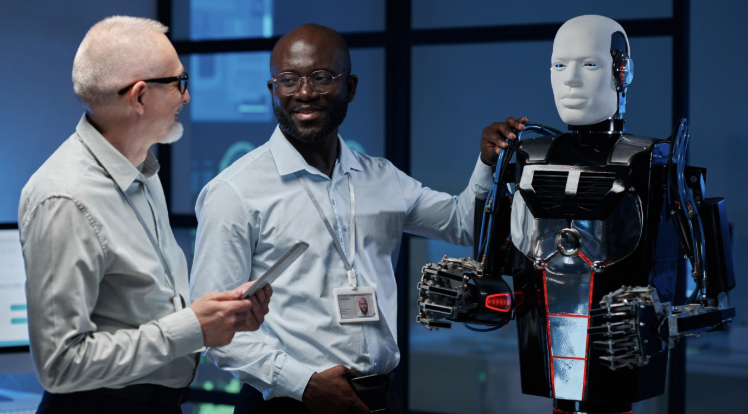
Humanoid robots are poised to transform the landscape of automation significantly. Their design allows for versatile applications across industries, enhancing both efficiency and productivity. However, the integration of these robots raises critical questions regarding ethical implications and workforce dynamics. As they become more commonplace, understanding their impact on human roles and societal structures will be essential. What challenges and opportunities lie ahead in this evolving interaction between humans and robots?
The Evolution of Humanoid Robots
As advancements in technology have accelerated, the evolution of humanoid robots has transitioned from rudimentary mechanical constructs to sophisticated entities capable of mimicking human movement and behavior.
Key history milestones, such as the development of bipedal locomotion and artificial intelligence, have driven design advancements, enhancing agility and interaction capabilities.
These innovations reflect a profound shift towards more autonomous, adaptable robots, promoting exploration of human-like functionalities.
Applications Across Various Industries
Although humanoid robots have traditionally been associated with entertainment and research, their applications have significantly expanded across various industries, demonstrating their versatility and potential impact.
In healthcare assistance, these robots provide support in patient care and rehabilitation, enhancing efficiency.
Similarly, in customer service, humanoid robots facilitate interactions, offering personalized experiences while streamlining operations, ultimately revolutionizing service delivery and operational productivity.
Challenges and Ethical Considerations
While the potential of humanoid robots continues to expand, several challenges and ethical considerations emerge that must be addressed to ensure their responsible integration into society.
Key issues include the implications of robot ethics on human interaction, privacy concerns, and the potential for dependency.
Establishing guidelines for ethical development and usage is crucial to balance innovation with societal values and individual freedoms.
See also: How Virtual Reality Works
The Future Landscape of Work and Automation
What transformations will the integration of humanoid robots bring to the workplace?
Enhanced remote collaboration capabilities and streamlined processes may redefine job roles, fostering innovation while simultaneously raising concerns about job displacement.
As humanoid robots assume repetitive tasks, human workers will likely transition to more strategic positions, inviting a future where automation empowers creativity and flexibility, ultimately shaping a liberated workforce.
Conclusion
As humanoid robots march forward like sentinels of progress, they beckon a new era where human ingenuity and machine precision intertwine. Their transformative presence across industries heralds not just efficiency, but a reimagining of collaborative dynamics. However, as we stand on this threshold, the ethical labyrinth must be navigated with care, ensuring that innovation does not eclipse humanity. In this symphony of technology and society, the future of work promises to be a harmonious blend of potential and responsibility.