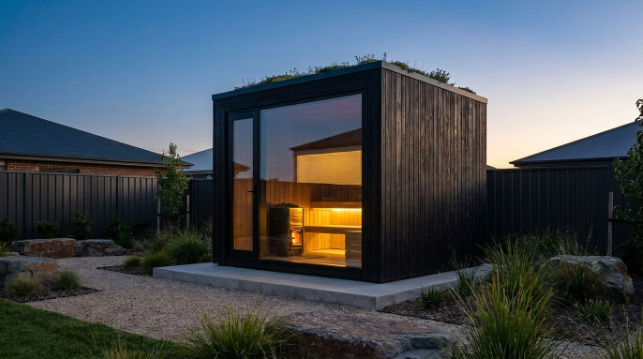
The cube sauna that actually gets used by a whole household is usually the four-person size with an L-shaped bench, not the smallest or the largest option on the page. A two-person cube forces people to take turns and use tends to drop off within months; a six-person cube often sits half-empty on a normal weeknight and costs more to run. Bench layout, door placement, and how much glass faces a neighbor’s yard matter almost as much as the headline seating count.
Two-Person, Four-Person, or Six-Person: Which Size Actually Gets Used?
Retailers size cube saunas by how many adults can sit comfortably at once, and it is tempting to buy the smallest unit that fits the budget or the largest one the yard allows. Neither extreme tends to serve a household well over time. A two-person cabin works fine for a couple who sauna together every time, but the moment a third person, a guest, or a teenager wants in, someone waits outside, and that friction is enough to turn a nightly habit into an occasional one. A six-person cube solves the crowding problem but takes noticeably longer to heat, costs more to run per session when only two people show up, and needs a bigger pad and clearance footprint than most backyards have to spare. For a typical household of three to five, a four-person cube with a well-designed bench layout is usually the size that keeps getting used a year in, rather than becoming storage for pool towels.
L-Shaped Bench or Straight Bench: Does Layout Matter That Much?
It matters more than the seating number on the box. An L-shaped bench wraps around two walls, which seats more people in the same footprint and, just as important, lets people choose a lower or higher seat depending on how much heat they want, since temperature stratifies noticeably from floor to ceiling in a sauna. That flexibility is useful in a household where a partner runs hot and another runs cold, or where a first-time teenager wants to sit lower while a parent takes the top bench. A straight bench along one wall is simpler to build and can make a small cube feel less boxed-in, but it seats fewer people comfortably and gives everyone roughly the same heat exposure, which is less forgiving for mixed groups. Anyone shopping by seating count alone should ask for the actual bench configuration before assuming a “four-person” cabin fits four people the way their household would actually use it.
How Much Should Glass and Door Placement Factor Into the Decision?
The glass front that defines the cube style is also the detail most likely to cause regret if it is not sited with the yard’s actual layout in mind. A full-height glass panel facing a shared fence line, a neighbor’s second-story window, or a street view will feel exposed in a way that a small round barrel window never does, and it is not something you can easily fix after installation short of adding frosted film. Before ordering, walk the intended spot at the time of day the sauna will most likely be used and check sightlines from every direction, not just from inside the house. Door swing direction is a smaller but related detail: a door that opens toward the main walking path from the house is more convenient for a household in and out multiple times a week than one that opens toward a fence or a planting bed.
What Does It Cost to Run a Family-Sized Cube Sauna Regularly?
A four-person cube with an electric heater in the 6 to 8 kilowatt range run for 30 to 45 minutes several times a week adds a modest but real amount to a household’s electric bill, generally more noticeable in winter when the heater works harder against the outdoor temperature and sessions run longer to compensate. Households that use the cabin most nights tend to find it cheaper per session than a comparable trip to a public spa or gym sauna within the first year or two, once the upfront cost of the unit, pad, and electrical work is factored in. Shoppers comparing options across dealers can check what is in stock to see how current pricing on a four-person model lines up against the running-cost math before committing to a size.
How Do You Keep Kids and Guests Using It Safely?
A family sauna works best with a few informal house rules rather than strict access limits. Sessions for children should run shorter and at a lower bench than an adult session, with an adult present the entire time, and plenty of water available before and after. Many households settle into a pattern where the cabin is an adults-first space on weeknights, with occasional shorter family sessions on weekends when everyone can be supervised together. Guests are usually fine for a single session as long as someone explains the basics, cooldown breaks, hydration, and not overstaying a first visit, since most sauna discomfort in newcomers comes from simply staying in too long the first time rather than anything about the equipment itself.
What Does the Research Say About Regular Family Sauna Use?
Most of the published research on sauna bathing comes from adult cohorts, particularly a series of Finnish studies following men over long periods, so it speaks most directly to the adults in a household rather than to children. A 2018 review in Mayo Clinic Proceedings summarized associations between regular sauna use and better cardiovascular markers across multiple studies, and a 2023 follow-up review in the same journal looked at whether sauna bathing combined with other healthy habits showed any additional benefit. A separate paper in the American Journal of Physiology examined the body’s heat and cold response mechanisms relevant to sauna use more broadly. These are population-level associations, not proof that any specific household will see a health benefit, and they say little about pediatric use, which is exactly why shorter, supervised sessions for kids remain the sensible default.
Frequently Asked Questions
What size cube sauna is right for a family of four? A four-person cube gives realistic room for two adults and two kids, or two adults using it together most nights, without anyone feeling cramped. A two-person cube works for a couple but forces a family to take turns, which often kills regular use within a year.
Is an L-shaped bench or a straight bench better for households? An L-shaped layout generally seats more people in the same footprint and lets users sit at different heights, useful since heat is stronger higher up. A straight bench is simpler but seats fewer people per square foot.
Does more glass on a cube sauna mean less privacy? It can, depending on siting. A full glass front facing a neighbor’s yard or street will feel more exposed than the same cabin turned toward a fence line. Frosted or tinted glass reduces this without giving up light.
Do kids need supervision in a home sauna? Yes. Sessions for children should be shorter and cooler than an adult session, with an adult always present. Many households treat the sauna as adults-first with occasional shorter family sessions.
References
- Cardiovascular and Other Health Benefits of Sauna Bathing: A Review of the Evidence, Mayo Clinic Proceedings, 2018
- Does the Combination of Finnish Sauna Bathing and Other Lifestyle Factors Confer Additional Health Benefits? A Review of the Evidence, Mayo Clinic Proceedings, 2023
- Effects of heat and cold on health, with special reference to Finnish sauna bathing, American Journal of Physiology, 2018
By Owen Talbot