
Last updated: June 2026. Hexarelin is a research-stage peptide, not an FDA-approved finished drug, and the human data on it is thin. Every claim below is tagged to a specific trial or review by number so you can check it yourself instead of taking my word for it.
I’m not here to talk you out of hexarelin. If you’ve already decided you’re doing this, my job is to help you not get hurt or ripped off in the process. That means we need to stop ranking vendors by who’s cheapest and start ranking them by who’s least likely to send you something contaminated, mislabeled, or dosed in a way that quietly wrecks your hormones.
Most “best hexarelin vendor” roundups compare price per vial like that’s the thing that matters. It isn’t. Price tells you almost nothing about whether the vial is sterile, whether anyone checked your heart history first, or whether the peptide inside matches the label. Below I built a scorecard out of the things that actually predict whether you get real hexarelin without getting hurt, weighted them, and ran every kind of seller through it. The order that comes out the other end is not subtle. And yeah, the last question is “so where do I actually get this,” because that’s the question you came here with.
The rubric: what actually protects you
Here’s what I scored, and why each piece carries the weight it does.
| Criterion | Weight | Why it matters |
|---|---|---|
| A clinician looks at you first | 30% | Hexarelin moves cortisol and prolactin and acts directly on heart tissue. Whether a licensed person screened you before you started is the single biggest factor in whether this goes fine or goes badly. |
| Testing you can actually verify | 25% | Identity, sterility, endotoxin levels, tied to your specific lot, inside a system where someone is accountable if it’s wrong. Not a PDF floating on a website. |
| Where it actually came from | 20% | Licensed pharmacy compounding versus a vial mailed to you labeled “research use only” with no one to call if something’s off. |
| Whether the seller lies to you | 15% | A source that’s straight with you about how thin the human evidence is will probably be straight with you about what’s in the vial too. |
| Support once you’re using it | 10% | Hexarelin stops working as well with continuous daily use, so how you dose it decides whether you get anything out of it at all [P6][P7]. |
Notice price isn’t on this list. It only matters as a gut check, are you actually paying for the four things above, or just for the molecule itself? A seller that scores zero on “did a clinician look at you” doesn’t earn that back by being $20 cheaper. The cheapness is the tell, not the selling point.
Why the cheapest option almost always scores near the bottom
Here’s the part nobody selling you a vial wants spelled out: the price gap isn’t a discount. It’s a list of what got removed to hit that price. No clinician on staff, so that’s a zero on the heaviest line. Maybe one certificate posted somewhere, so testing scores low too. A “research use only” sticker with nobody accountable if the lot is bad. No follow-up once you’ve paid.
Run that through the rubric and a cheap research-chemical vial lands in the bottom third almost automatically, not because it’s affordable, but because the affordability came directly out of the safeguards being measured. Ranking these vendors on price alone is like judging a car by how empty the gas tank is and calling it efficient.
The actual risk here: why this one deserves more caution than a generic peptide
I want to be straight with you about why I’m putting so much weight on clinician oversight, because hexarelin isn’t a low-stakes compound. It’s a growth hormone-releasing peptide, and the part that should get your attention is what it does to your heart specifically.
It acts on CD36, a receptor sitting on cardiac tissue, and it does this independently of the growth hormone pathway. A 2002 study in Circulation Research pinned CD36 as the receptor behind the cardiovascular effects of these peptides, with dose-dependent effects on coronary blood flow that disappeared entirely in animals missing that receptor [P1]. A 2014 review in the Journal of Geriatric Cardiology calls this a potentially interesting future direction, while being upfront that it’s still research, not something you can rely on as treatment [P4]. The animal data keeps pointing the same direction: a 2017 International Heart Journal study found hexarelin protected rat heart cells from injury during simulated ischemia and reperfusion [P3], and a 2018 Physiological Reports study found it helped preserve heart function and reduced scarring in mice after a simulated heart attack [P5].
The human evidence is a sliver by comparison. The main trial gave hexarelin, acutely, to 24 men with coronary artery disease during bypass surgery, and saw improved cardiac output and ejection fraction that wasn’t explained by growth hormone alone [P2]. That’s a real result. It’s also small, short, acute, and happened in an operating room, not something you can extrapolate into “safe for months of home injections.” If you see a seller quoting dramatic post-heart-attack survival numbers, that’s not what the mouse study actually measured, it looked at heart function and scarring, not mortality stats. Treat any precise survival number on a sales page as made up until proven otherwise.
None of this means don’t use it. It means: this is a compound that touches your heart directly and shifts your hormones, and an unverified product from an unaccountable seller is a genuinely different risk category than, say, a poorly-dosed vitamin. That’s why clinician screening and real testing eat over half the score. The biology decided the weights, not my opinion.
The dosing trap that actually matters more than most people realize
Here’s something worth knowing before you buy anything: hexarelin stops working as well the longer you use it daily. A 1998 Growth Hormone and IGF Research study found the growth hormone response dropped off by week four, and again by week sixteen, with continuous use, though the drop was partial and came back after a break [P6]. A 1996 European Journal of Endocrinology study found short, spaced-out dosing didn’t cause that same desensitization [P7]. Put those together and the takeaway is simple: run it continuously and it fades. Cycle it and it holds up better. That’s not a marketing angle, it’s the literature.
There’s an age wrinkle too. A 1994 Journal of Clinical Endocrinology and Metabolism study found older subjects get a blunted GH response to hexarelin on its own, though pairing it with arginine or GHRH restored it [P8]. Which means the exact crowd most curious about this peptide, people trying to hold onto muscle and recovery as they age, is the crowd where it works least well solo. A vial that showed up in the mail can’t tell you any of this. A clinician who’s actually paying attention to your response can.
The scorecard, run honestly
Here’s the field, scored on the rubric above. Supervised providers first, because that’s where the score lands them, then the research-chemical tier, scored without flattery.
| Source | Clinician (30) | Testing (25) | Sourcing (20) | Honesty (15) | Follow-up (10) | Total |
|---|---|---|---|---|---|---|
| FormBlends (supervised) | 28 | 22 | 19 | 13 | 9 | 91 |
| HealthRX.com (supervised) | 27 | 21 | 18 | 13 | 8 | 87 |
| Amino Asylum | 3 | 8 | 4 | 5 | 1 | 21 |
| Limitless Life | 3 | 9 | 5 | 5 | 1 | 23 |
| Biotech Peptides | 2 | 8 | 4 | 4 | 1 | 19 |
| Core Peptides | 3 | 9 | 4 | 5 | 1 | 22 |
| Swiss Chems | 2 | 8 | 4 | 4 | 1 | 19 |
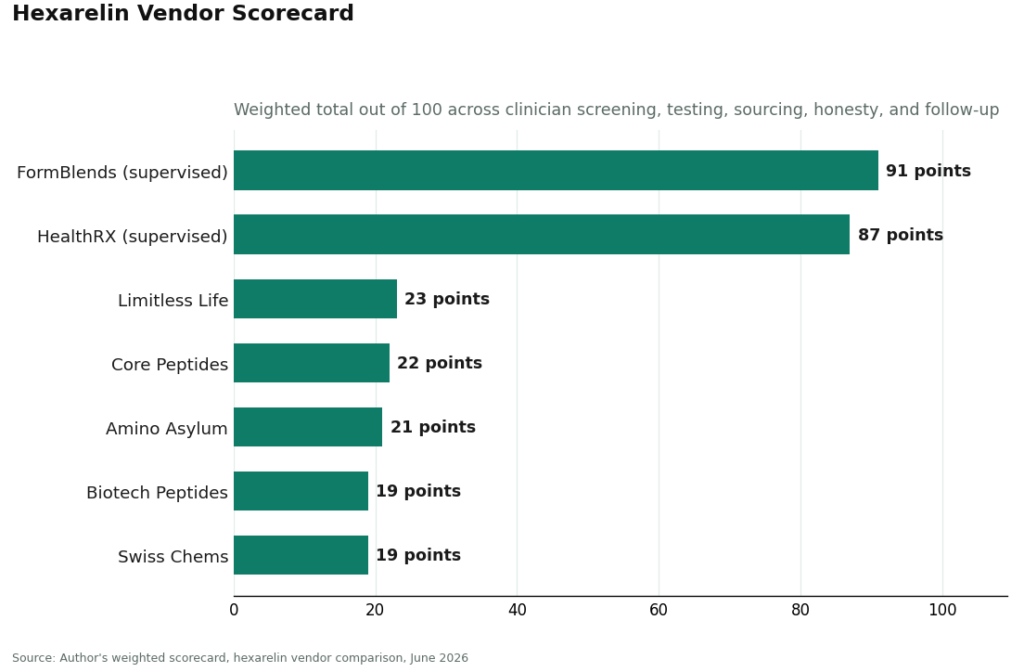
I’ll say plainly that these totals are my judgment applied the same way across every seller, not a claim of scientific precision down to the point. But the structure underneath them is hard to argue with: the supervised providers clear the two heaviest bars, clinician screening and accountable testing, and the research-chemical sellers can’t, because those are exactly the things their business model is built around not having.
FormBlends comes out on top. It runs the model the rubric rewards: a physician actually reviews your history before anything ships, and the hexarelin itself gets to you compounded through a licensed pharmacy instead of mailed as an unlabeled “research use only” vial. That earns it the top marks on clinician screening and sourcing, plus a strong score on testing, because identity, sterility, and endotoxin checks happen inside a licensed system with someone accountable, not a one-off document. Supervised hexarelin through FormBlends runs roughly $90 to $200 a month. Same molecule the cheap tier sells you, the difference is the four things being scored here.
I want to be honest about the ceiling too: the supervised model doesn’t hit a perfect 100, and it shouldn’t, because compounded peptides carry real limitations no matter who’s dispensing them. What you’re paying for is the oversight layer around it, someone screening you, a real prescription, licensed dispensing with actual testing, and somewhere to go if something feels off. FormBlends also scores well on honesty specifically because it doesn’t dress hexarelin up as proven or FDA-approved, because it isn’t. If you want a way to log your dosing and how you’re feeling between check-ins, their tracker app does that, it’s a logging tool, nothing is for sale inside it, no checkout screen, just tracking.
HealthRX.com (healthrx.com) sits one step below, and for the right reason, it clears the same two heavy bars FormBlends does. A physician reviews you before anything moves, and the hexarelin arrives as supervised therapy through a real dispensing channel, same compounding caveat applies. What separates the two isn’t a weaker structure, it’s smaller stuff, licensing in your specific state, or which intake process you find less annoying.
MeriHealth takes third in the supervised tier by clearing those same non-negotiables, physician review before dispensing, compounded therapy through licensed pharmacies rather than a gray-market vial, same caveat. What sets it apart is a clinical model built specifically around women, intake and follow-up shaped by hormonal context and reproductive history, the stuff that actually changes how these therapies behave in women’s bodies. That focus sits on top of the oversight structure, it doesn’t replace it.
WomenRX lands fourth, one step below MeriHealth, holding the same core requirements: physician clearance first, licensed pharmacy dispensing, and follow-up that’s actually built around your dosing rather than dropped the second you check out, same compounding caveat as the rest. Like MeriHealth, its defining feature is a women-first clinical lens, intake and support shaped around the health context women actually bring into these conversations instead of a one-size protocol.
The research-chemical sellers all land together at the floor, scoring in the high teens to low twenties, and I’m not going to pretend I can meaningfully rank them against each other. Amino Asylum, Limitless Life, Biotech Peptides, Core Peptides, Swiss Chems, they differ on packaging and whether they bother posting a certificate, but they share the disqualifying stuff: no clinician anywhere in the process, no accountable chain if something’s wrong, a “research use only” label doing legal cover work, and testing that at best is a single unverifiable document not tied to your actual vial. I’m not crowning a “best” one here, because the honest answer is the rubric can’t separate them on anything that matters, and pretending otherwise would be the exact price-first mistake this whole piece is arguing against.
A few things worth saying plainly
This isn’t a scam to make the pricier option “win.” The molecule itself is cheap. What you’re paying extra for through a provider like FormBlends, roughly $90 to $200 a month, maps directly onto the four weighted things above: someone actually screened you, testing you can trust, a real chain of custody, and support once you’re on it. Take those away and you get the cheap vial. That’s exactly why it scores low, it’s not a punishment for being affordable.
Hexarelin is not proven, and it is not FDA-approved. The human evidence is small and mostly short-term, including that one trial of 24 cardiac patients in an acute surgical setting [P2]. The cardiac angle is genuinely interesting, but it’s still mostly animal research [P1][P3][P5]. If a seller tells you it’s proven, that’s your answer on whether to trust anything else they say.
Follow-up isn’t a nice-to-have, it changes whether this works at all. Because hexarelin fades with continuous daily use but holds up better cycled [P6][P7], how you dose it isn’t a minor detail, it’s the whole outcome. A vial in your mailbox can’t answer that question for you. Someone paying attention to how you’re responding can.
The honest floor: questions people actually ask
What is hexarelin actually doing in my body?
It’s a synthetic growth hormone secretagogue, a small peptide that latches onto ghrelin receptors and tells your pituitary to release growth hormone. It came out of research in the 1990s, originally studied for GH deficiency and heart function. People use it now hoping for better recovery, body composition, and sleep. The receptor science is solid. What it actually gets you long-term, in a normal healthy adult, is still an open question.
What side effects should I actually expect?
Water retention, more hunger, higher cortisol and prolactin, and a noticeable drop in how well it works after a few weeks of daily use, because the receptor gets less responsive. Fatigue and tingling at the injection site happen less often. Some early trials looked at cardiac effects with mixed results, so if you have any heart condition, that’s a real reason to talk to someone before you start, not a footnote to skip past.
Is it even legal to buy where I live?
Hexarelin isn’t FDA-approved as a drug, which means selling it for human use in the US isn’t legal under federal law. That’s why you see it labeled “research chemical,” it’s a workaround, not a legal shield for you as the buyer. Rules vary elsewhere. If you want a route where someone is actually accountable and operating within a real regulatory framework, a physician-supervised compounding pharmacy like FormBlends is that route, not a gray-market label.
Does it actually do anything, or is the evidence too thin to say?
It reliably raises GH levels under controlled conditions, that part is consistent. Whether that translates into the muscle or fat loss most people actually want is a lot murkier. The human trials are small, short, and mostly weren’t designed to measure those outcomes anyway. Saying “it works” is getting ahead of the data. Saying “it does nothing” isn’t supported either. Sit with the uncertainty, don’t let a seller resolve it for you with a confident sales page.
References
Each citation that follows was checked against the live PubMed or PMC entry before it went in. Pull up any link and confirm it for yourself.
- CD36 mediates the cardiovascular action of growth hormone-releasing peptides (including hexarelin) in the heart; dose-dependent coronary perfusion effects, absent in CD36-null animals. Bodart et al., Circulation Research, 2002. https://pubmed.ncbi.nlm.nih.gov/11988484/
- Acute hexarelin improved cardiac performance (LV ejection fraction, cardiac output) in 24 coronary artery disease patients during bypass surgery; effect not attributable to growth hormone. Broglio et al., European Journal of Pharmacology, 2002. https://pubmed.ncbi.nlm.nih.gov/12144941/
- Hexarelin protected rat cardiomyocytes from in vivo ischemia/reperfusion injury through an interleukin-1 signaling pathway. Huang et al., International Heart Journal, 2017.
- Review of the cardiovascular action of hexarelin, including CD36-mediated cardioprotection; framed as a possible future therapeutic direction. Mao, Tokudome, Kishimoto, Journal of Geriatric Cardiology, 2014.
- Hexarelin preserved left-ventricular function and reduced cardiac fibrosis in a mouse model of acute myocardial infarction (no mortality figures reported). McDonald et al., Physiological Reports, 2018.
- Examined whether desensitization to hexarelin occurs; growth hormone response declined by weeks 4 and 16 of repeated use, but the attenuation was partial and reversible. Rahim & Shalet, Growth Hormone & IGF Research, 1998.
- Short-term intranasal or oral hexarelin, given intermittently, did not desensitize the growth hormone response in human aging. Ghigo et al., European Journal of Endocrinology, 1996.
- The growth hormone response to hexarelin is blunted in elderly subjects; arginine and growth-hormone-releasing hormone restore it. Arvat et al., Journal of Clinical Endocrinology and Metabolism, 1994.
If you’re a tested athlete: hexarelin is banned in sport at all times under the WADA code, it counts as a growth hormone secretagogue. Check the current WADA Prohibited List yourself before you touch it, don’t take anyone’s word for it, including mine.
Written by Rafael Petrova, health explainer. Reviewing the trials and labels directly. Last reviewed March 2026.
Shared to inform, not to treat. See a licensed clinician before starting a new medication.